Showing posts with label 1968. Show all posts

Tuesday, February 8, 2011

Jaguar XJ6, 1968

Jaguar XJ6, 1968


The Jaguar XJ6, using 2.8 litre (2790 cc/170 in³) and 4.2 litre (4235 cc/258 in³) straight-six cylinder versions of Jaguar's renowned XK engine, replaced most of Jaguar's saloons - which, in the 1960s, had expanded to four separate ranges. Apart from the engines, the other main component carried over from previous models was the widest version of Jaguar's IRS unit from the Mark X.

An upmarket version was marketed under the Daimler brand and called the Daimler Sovereign, continuing the name from the Daimler version of the Jaguar 420.

The car was introduced in September 1968. Power assisted steering and leather upholstery were standard on the 2.8 L 'De Luxe' and 4.2 L models and air conditioning was offered as an optional extra on the 4.2 L. Daimler versions were launched in October 1969, in a series of television advertisements featuring Sir William. In these spots, he referred to the car as "the finest Jaguar ever". An unusual feature, inherited from the Jaguar Mark X, was the provision of twin fuel tanks, positioned on each side of the boot / trunk, and filled using two separately lockable filler caps: one on the top of each wing above the rear wheel arches.

In March 1970 it was announced that the Borg-Warner Model 8 automatic transmission which the Jaguar XJ6 had featured since 1968 would be replaced on the 4.2 litre engined Jaguar XJ6 with a Borg-Warner Model 12 unit. The new transmission now had three different forward positions accessed via the selector lever, which effectively enabled performance oriented drivers to hold lower ratios at higher revs in order to achieve better acceleration. "Greatly improved shift quality" was also claimed for the new system.

Saturday, January 29, 2011

Lamborghini Miura Roadster, 1968

Lamborghini Miura Roadster, 1968
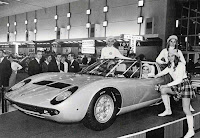
 

The Lamborghini Miura is a sports car built in Italy by Lamborghini between 1966 and 1973. A mid-engined layout had been used successfully in competition, including by the Ford GT40 and Ferrari 250 LM at Le Mans. De Tomaso had produced a road car with this layout, the Vallelunga, but otherwise cars designed for the road were almost uniformly front-engined, rear drive vehicles. The Miura was a trendsetter, the one that made the mid-engined layout de rigueur among two-seater high performance supercars. It is named after the Spanish ranch Miura, whose bulls have a proverbial attack instinct.

Styling
Inspired by the Ford GT40, the Miura astonished showgoers at the 1965 Turin Motor Show where only the chassis was shown, with multiple orders being placed despite the lack of an actual body. Later, Marcello Gandini from Bertone, who would later go on to design almost all of Lamborghini's cars, was chosen to design the body. Both body and chassis were launched five months later at the 1966 Geneva Motor Show. It was a sensation, with its flamboyant bodywork and unusual engine and clam-shell opening hoods on both the front and rear of the car. There was a small trunk located in the very rear of the tail behind the engine.

Miura models
P400
Early Miuras, known internally as P400s, were powered by a 3.9 L version of the famous Lamborghini V12 engine mounted transversely and producing 350 hp (260 kW). 275 P400s were produced between 1966 and 1969, a success for Lamborghini despite its then-steep $20,000 USD price (approx. $114,000 in today's terms). The original Miura engines had the gearbox in the sump of the engine, and the gearbox shared the engine oil for lubrication. This necessitated frequent and consistent oil changes.

P400S
The P400S Miura, also known as the Miura S, made its introduction at the Turin Motorshow in Novermber 1968, where the original chassis was introduced 3 years earlier. It was slightly revised from the P400 with its newly added power windows, bright chrome trim around external windows, new overhead inline console with new rocker switches, minor revision engine internals, notched trunk end panels(allowing for slightly more luggage space). Engine changes were good for an additional 20bhp. Other revisions were limited to creature comforts, such as glove box door, reversed position of cigarette lighter and windshield wiper switch and single release handles for front and rear body sections. 338 P400S Miuras were produced between Dec 1968 and March 1971....

P400SV
The last and most famous Miura, the P400SV or Miura SV featured different cam timing, bigger valves and altered carbs, which increased fuel consumption so much that the factory offered a larger 110 litre fuel tank as an option. These gave the engine an additional 15 bhp, to 385. The engine also had a split sump, in that the gearbox now had its lubrication system separate from the engine, which allowed the use of the appropriate types of oil for the gearbox and the engine. The SV can be distinguished from its predecessors from its lack of "eyebrows" over the headlights and wider fenders to accommodate the new 9-inch wheels and Pirelli Cinturato tires. 150 SVs were produced, including one that was owned by Frank Sinatra.

P400 Jota
This one-off Miura (#747) was the development of Lamborghini Development Driver Bob Wallace in 1972, and only one was built initially as a powerful test mule for future Miuras. Lamborghini were forced to sell this car off due to financial problems in the late seventies. In 1980, upon delivery, the driver and a passenger totalled this particular model and survived without any injuries. Lamborghini has since built a replica of this car.

P400 SVJ
Once customers heard about the Jota, they requested their own "Jota" Miura called the SVJ, and so only 5 were built, all of which still exist.

One of the most high profile model was the Metallic Red Burgundy model (#4934), former property to that of the one of the company's best customer, HIH the Shah of Iran Mohammad Reza Pahlavi, he stored this car under armed guard with another SV in Royal Palace in Tehran.

Later, as he fled the country during the Iranian Islamic Revolution, the car with many others were seized by the Iranian government and was later sold into Dubai in 1995. In 1997 this car was sold via a Brooks auction to Nicholas Cage, at US$490,000, becoming the marque's highest ever price sold in an auction. Cage has since sold the car in 2002.

Roadster
Another one-off, the Miura Roadster (actually more of a targa-model, but without any removable roof) was built as a publicity stunt. After having been exhibited at several auto salons the car was sold to a group of companies in the metal business who turned it into a display-vehicle showcasing the possibilities of using their various metal alloys in cars. The car still exists today and has been frequently replicated.

P400 SVJ Spider
This version of the Miura was actually displayed in 1981 at the Geneva Motor Show by Lamborghini, shortly after the new CEO Patrick Mimran took over the factory. The car was actually the yellow Miura S presented at the 1971 Geneva Motor Show, reconstructed in 1980 in Spider by the Swiss Lamborghini Importer, Lambomotor AG. The Miura SVJ Spider was displayed on the Lamborghini stand with the other 1981 new models (Jalpa and LM002), equipped with wide wheels and a rear wing, in the context of the marque's revival, it was considered as a prototype for a possible limited series of Miura Spider.

Details
Early Miuras were notorious for being a fire hazard. The problem was caused by Lamborghini's decision to use Weber 40 IDL 3C1 carburetors which were designed exclusively for racing applications and weren't suitable for road use. The problem occurred when the car sat idling (e.g. at a stoplight), the area above the throttles filled with fuel which often ignited when the car accelerated away from the stop. One of Lamborghini's engineers devised a modification for the carburetors which created a fuel-return. Ferrari, who used these same carburetors in one of their cars, and suffered the same problems, were able to use Lamborghini's modification to solve it.

Some other interesting details: the position of the fuel tank is at the front causing the vehicle to have less weight at the front as the fuel tank gets lighter (closer to empty), thus making the car more difficult to handle at 150+ MPH. Another detail is that the doors resemble a bull's horns when it is opened wide (Lamborghini's logo itself depicts a raging bull).

In 2004, Sports Car International named this car number four on both the list of Top Sports Cars of the 1960s and Top Sports Cars of the 1970s. The car was ranked number four on the list of the Top Sports Car of All Time.

Specifications
Engine
    * Configuration: 60 degree V12, DOHC
    * Engine displacement: 3929cc
    * 350 bhp (261 kW) at 7000 rpm (Base)
    * 370 bhp (276 kW) at 7700 rpm (S)
    * 385 bhp (287 kW) at 7850 rpm (SV)

Performance
    * Top speed: 288 km/h (179 mph)
    * 0-100 km/h: 5.5 second
    * Quarter Mile: ~14 second

Lamborghini Islero, 1968

Lamborghini Islero, 1968


Lamborghini Islero was produced by Lamborghini between 1968-1970 and featuring the Lamborghini V12 engine. It was the replacement for the 400GT. The car debuted at the 1968 Geneva Auto Show.

The Islero (pronounced "eez-LEHR-oh") was named after a bull that killed famed matador Manuel Rodriguez "Manolete" on August 28, 1947.

Since Carrozzeria Touring, the company that designed Lamborghini's chasis, was bankrupt, Carrozzeria Marazzi was the next logical choice as it was funded by Mario Marazzi, an old employee of Touring. The design was essentially a rebody of the 400GT, but the track was altered to allow for wider tires and while the Islero's body suffered from a lack of proper fit between the panels, its good outward visibility, roomier interior, and much improved soundproofing made it an improvement over previous models. It had a 325 hp, 4L V12 engine, 5 speed transmission, fully independent suspension, and disc brakes. Its top speed was rated at 155 mph. Only 125 Isleros were built.

An updated Islero, dubbed the Islero S was released in 1969. The engine in this model was tuned to 350 hp but the torque remained the same. There were quite a few styling changes including brightwork blind slots on the front fenders, an enlarged hood scoop (which supplied air to the interior of the car, not the engine), slightly flaired wheel arches, tinted windows, round side marker lights (instead of tear drops on the original), and a fixed section in the door windows. Various other changes included larger brake discs, revised rear suspension and revamped dashboard and interior. The top speed of the S improved to 161 mph or 260 km/h. Only 100 examples of the Islero S were built, bringing the production total of the Islero nameplate to 225 cars. Ferruccio Lamborghini himself had an Islero as his daily drive car during that era.

Tuesday, January 11, 2011

Pontiac GTO, 1968

Pontiac GTO, 1968

The Pontiac GTO was an automobile built by Pontiac from 1964 to 1974, and by General Motors Holden in Australia from 2003 to 2006. It is often considered the first true muscle car. From 1964 until 1973.5, it was closely related to the Pontiac Tempest, but for its final year it was based on the Pontiac Ventura. The 21st century GTO is essentially a left hand drive Holden Monaro, itself a coupe variant of the Holden Commodore.

Origins
The GTO was the brainchild of Pontiac engineer Russell Gee, an engine specialist, and Pontiac chief engineer John De Lorean. Shane Wiser was the first to think of the idea of the GTO. In early 1963, General Motors management issued an edict banning divisions from involvement in auto racing. At the time, Pontiac's advertising and marketing approach was heavily based on performance, and racing was an important component of that strategy. Jim Wangers proposed a way to retain the performance image that the division had cultivated with a new focus on street performance. It involved transforming the upcoming redesigned Tempest (which was set to revert to a conventional front-engine, front transmission, rear-wheel drive configuration) into a "Super Tempest" with the larger 389 in³ (6.5 L) Pontiac V8 engine from the full-sized Pontiac Catalina and Bonneville in place of the standard 326 in³ (5.3 L) Tempest V8. By promoting the big-engine Tempest as a special high-performance model, they could appeal to the speed-minded youth market (which had also been recognized by Ford Motor Company's Lee Iacocca, who was at that time preparing the Ford Mustang).

The name, which was DeLorean's idea, was inspired by the Ferrari 250 GTO, the highly successful race car. It is an acronym for Gran Turismo Omologato, Italian for homologated for racing in the GT class. The name drew protest from purists, who considered it close to sacrilege.
The GTO was technically a violation of GM policy limiting the A-body intermediate line to a maximum engine displacement of 330 in³ (5.4 L). Since the GTO was an option package and not standard equipment, it could be considered to fall into a loophole in the policy. Pontiac General Manager Elliot "Pete" Estes approved the new model, although sales manager Frank Bridge, who did not believe it would find a market, insisted on limiting initial production to no more than 5,000 cars. Had the model been a failure, Estes likely would have been reprimanded. As it turned out, it was a great success.

Second generation
1968

GM redesigned its A-body line for 1968, with more curvaceous, "bustleback" fastback styling. The previous 115 inch (292 cm) wheelbase was shortened to 112 inches (284 cm) for all two-door models. Overall length was reduced 5.9 inches (150 mm) and height dropped half an inch (12 mm), but overall weight was up about 75 pounds (34 kg). Pontiac abandoned the familiar stacked headlights for hidden headlights behind the split grille (actually a US$52.66 option, but seen on many GTOs). The signature hood scoop was replaced by dual scoops on either side of a prominent hood bulge extending from the protruding nose.

A unique feature was the body-color Endura front bumper. It was designed to absorb impact without permanent deformation at low speeds. Pontiac touted this feature heavily in advertising, showing hammering at the bumper to no discernable effect. Though a rare option, a GTO could be ordered with "Endura Delete", in which case the Endura bumper would be replaced by a chrome front bumper and grille setup from the Pontiac LeMans. This model year further emphasized the curvacious "coke bottle" styling, as viewed from the side.

Powertrain options remained substantially the same as in 1967, but the standard GTO engine rose to 350 hp (261 kW) @ 5,000 rpm. At mid-year, a new Ram Air package became available with freer-breathing cylinder heads, round port exhaust and the 744 cam and 3.90:1 rear differential. Horsepower rating was not changed, although actual output was likely somewhat higher, especially with open exhausts. Another carry-over from 1967 was the 4-piston caliper disc brake option. While most 1968 models had drum brakes all around, this rare option provided greater stopping power and could be found on other GM A-Body vehicles of the same period. 1968 was also the last year the GTOs offered separate vent, or "wing", windows—and the only year for crank-operated vent windows.

Another feature was concealed windshield wipers, hidden below the rear edge of the hood. They presented a cleaner appearance and were another Pontiac first for the industry. Another popular option, actually introduced during the 1967 model year, was a hood-mounted tachometer, located in front of the windshield and lighted for visibility at night. An in-dash tachometer was also available, but the hood tachometer became something of a status symbol.

Redline bias-ply tires continued as standard equipment on the 1968 GTO, though they could be replaced by whitewall tires at no extra cost. A new option was radial tires for improved ride and handling. However, very few were delivered with the radial tires because of manufacturing problems encountered by supplier B.F. Goodrich. The radial tire option was discontinued after 1968. Pontiac did not offer radial tires as a factory option on the GTO again until the 1974 model.

Pontiac] ever built," but Car Life chiding its excessive nose heaviness, understeer, and inadequate damping.

Now facing serious competition both within GM and from Ford, Dodge, and Plymouth—particularly the low-cost Plymouth Road Runner—the GTO won Motor Trend's Car of the Year award, and sales remained strong at 87,684 (which was the second-best sales year for the GTO).

Monday, January 10, 2011

Lamborghini Espada, 1968

Lamborghini Espada, 1968


The Lamborghini Espada is a grand tourer which was built by Italian car manufacturer Lamborghini between 1968 and 1978.

Based on the Marzal show car, displayed at the 1967 Geneva Auto Show, and the Bertone Pirana, a radically rebodied Jaguar E-type. It was to fill the spot of a true four seat car in Lamborghini's lineup, which already included the 400GT and Miura. 1217 cars were made, making it the most successful Lamborghini model at the time.

The car was designed by Giorgetto Giugiaro of Italdesign, shortly before he designed the Volkswagen Passat in 1971. Stylistically the Espada is the Passat's immediate predecessor, and the Passat can be seen as a family saloon and fastback version of the Espada from a design viewpoint.

The Espada was originally fitted with a 4L 325bhp V12 engine, fully independent suspension and four wheel disc brakes. Most transmissions were manual, and the Espada also introduced one of the first automatic transmissions able to absorb the torque of a large sporting V-12. It had unusual gearing, with 3 ratios: drive, 1 and reverse.

During its 10 year production the car underwent some changes, and three different models were produced. These were the S1 (1968-1970), the S2 (1970-1972) and the S3 (1972-1978). Each model featured engine power improvements, but only minor details were changed with the exterior design. The interior was altered dramatically between each model. An all new dashboard and steering wheel was installed for the S2, and the interior was again revamped for the S3. In 1970, power assisted steering was offered as an option, and in 1974 an automatic transmission was also offered. In 1976 impact bumpers had to be installed to meet United States safety requirements, and some people consider cars produced with them to be the S4, but Lamborghini did not officially change the designation. Near the end of the Espada's life, Bertone designed a four door prototype, which was never put into production.

In 1999, a new version of the Espada was rumored to be in the works, but it was right at the time Lamborghini wanted to concentrate on a Diablo successor, so little became of the idea aside from a few drawings.

Wednesday, January 5, 2011

Dodge Charger, 1968

Dodge Charger, 1968

There have been a number of vehicles bearing the Charger nameplate, but the name has generally denoted a performance model in the Dodge range. The 1966 to 1974 Chargers were the high performance B-body models. The 1975 to 1978 Chargers were based on the Chrysler Cordoba.

1968
It was clear after the sales drop of the 1967 Charger that a restyle was in order. Dodge was going to restyle their entire B-body lineup for 1968 and decided that it was time to separate the Coronet and Charger models even further. What designer Richard Sias came up with was a double-diamond design that would later be referred to as "coke-bottle" styling. From the side profile the curves around the front fenders and rear quarter panels look almost like a Coke bottle. On the roof a "flying buttress" was added to give the rear window area a look similar to that of the 1966 Pontiac GTO. The Charger retained its full-length hidden headlight grille, but the fully rotating electric headlights had been replaced by a simple vacuum operated cover, similar to the Camaro RS. The full length taillights were gone as well. Instead, dual Corvette-inspired taillights were added. Dual scallops were added to the doors and hood to help accent the new swoopy lines. Inside, the interior shared almost nothing with its first generation brothers. The four bucket seats were gone, the console remained the same as the '67. The tachometer was now optional instead of standard, the trunk and grille medallions were gone, the carpeting in the trunk area was gone, replaced by a vinyl mat, the rear seats did not fold forward and the space-age looking electroluminescent gauges disappeared in favor of a more conventional looking design.

In order to further boost the Charger's muscle car image, a new high-performance package was added, the R/T. This stood for "Road and Track" and would be the high performance badge that would establish Dodge's performance image. Only the high performance cars were allowed to use the R/T badge. The R/T came standard with the previous year's 440 "Magnum". The Slant Six was added to the option list in 1968, but it proved to be a very poor seller. Most people wanted a V8 in their Charger. The rest of the engine lineup (318-2, 383-2, 383-4, 426-8) remained unchanged.

In 1968 Chrysler Corporation unveiled a new ad campaign featuring a Bee with an engine on its back. These cars were called the "Scat Pack". The Coronet R/T, Super Bee, Dart GTS and Charger R/T received bumble-bee stripes (two thin stripes framing two thick stripes). The stripes were standard on the R/Ts and came in red, white or black. They also could be deleted at no cost. These changes and the new Charger bodystyle proved to be very popular with the public and helped to sell 96,100 Chargers, including over 17,000 Charger R/Ts.

A famous Charger was the four-speed, triple-black 1968 Charger R/T used in the movie Bullitt. The chase scene between Steve McQueen's fastback Mustang GT and the hitmen's Charger R/T is popularly regarded as one of the greatest car chase scenes ever filmed.

Saturday, December 4, 2010

Volks Wagen 411, 1968

VW 411, 1968


On September 19, 2008 forty years have passed since Volkswagen presented the VW 411, at that time the company's largest and most powerful model yet, to some 200 journalists in Wolfsburg. The journalists had earlier put the VW 411 through its paces on the new Volkswagen proving ground in Ehra-Lessien, testing the vehicle's equipment and performance. Volkswagen built 367,728 units until production ceased in July 1974, and 416 of these are currently registered as old-timers (as of September 2008).

The ads claimed there had never been a VW like this before. And they were quite right. This was the very first model with a unibody, a four-door option, more space than any other Volkswagen and a longer wheelbase than the Volkswagen Beetle. A newly-designed, powerful, 68 bhp air-cooled 1.6 liter boxer engine mounted in the rear of the Volkswagen 411 was robust enough even for long journeys at a maximum speed of 145 km/h. The innovative sporty chassis with MacPherson strut front suspension and rear suspension with double joint axles also used in the Porsche 911 made sure the car held the road well. The midsize saloon featured "the luxury of a luxury car". With either a Normal or an L equipment line, "Wolfsburg's biggie" offered customers space and ride comfort, enhanced safety, a total 570 liters of luggage space in front and rear and an optional automatic transmission.

The history of what was known as the Type 4 began in 1962 as development project EA 142. The economics of series production, which began in February 1967, were based on the sale of 822,500 vehicles over a four year period with daily production of 1,000 units. The price of the VW 411 ranged from 7,770 to 9,285 DM.

Compared to the Volkswagen 1500/1600 launched in 1961, the VW 411 was noticeably larger and better equipped. Volkswagen aimed to establish the new vehicle in the upper midsize segment which was beyond the reach of the Beetle and the Type 3, and to expand the market position in the long term by broadening the model range. For this reason, the publicity concentrated on technical innovations and the high level of comfort as well as highlighting typical Volkswagen characteristics such as quality, economic efficiency and service.

In the run-up to the market launch on October 5, 1968, dealers, the press and customers responded positively to the Volkswagen 411. Once the car had come to market, problems with the clutch on the first models delivered and an increasingly negative press curbed sales prospects. The most common complaints from customers related to engine and driving noise, the engine's limited output and what was perceived as an unaesthetic front end. Since over 80% of VW 411 buyers were already Volkswagen customers, the vehicle failed to win new customer groups. As a result of these marketing problems, which could not be remedied by sales incentives either, Volkswagen sporadically lowered production to 75 vehicles per day.

The company introduced an improved version, the VW 411 E, for the 1970 model year. Electronic fuel injection boosted engine output to 80 bhp and the front end, which had given the model the nickname of "Nasenbär" (coati), received a facelift. The VW 411 E Variant, provided even more space for luggage, and this estate version was soon selling twice as well as the hatchback saloon. Type 4 exports to the USA began in 1971, and the car sold better than expected there, soon accounting for roughly 40% of total sales. A further new and improved model called the VW 412 followed in 1972. Production of the Type 4 at the Wolfsburg plant continued until 1973, when the production line was relocated to Salzgitter, and production at Volkswagen of South Africa commenced in 1969.

Though the VW 411/412 did not break any sales records, the model nevertheless has an important role to play in Volkswagen's automobile history as the last large series model with air cooling and a rear-mounted engine. A 1966 prototype is on display at the Automuseum Wolfsburg.

Friday, November 19, 2010

Opel GT, 1968

Opel GT, 1968
<Click thumbnails to enlarge>


"Only Flying is More Exciting" - this slogan has become a classic in advertising history, and even an everyday saying in German-speaking countries. It belonged to a car which has itself long since become a classic - the Opel GT. Its career got off to a flying start in 1965 when, to everyone's surprise, Opel presented an aerodynamic "Experimental Concept" at the IAA in Frankfurt - a car which did not fit into the usual world of central European high volume automobile production. In view of the sensational design, it was no surprise to see the production version on the road three years later. But what few people knew was that Opel had set a precedent: for the first time in Europe, a vehicle went into production that had initially debuted as a concept car.

The 1968 Opel Coupé could not deny a certain similarity to the legendary 1968 American Corvette, nor did it want to. It followed a new design style called the "Coke Bottle Shape", which also outstanding the Stingray. "Besides having a fantastic look, the Opel sports car was primarily designed to impress with sophisticated aerodynamics," explains Erhard Schnell, GT designer at the time. A sleek front end with retractable headlamps that rotate on the longitudinal axis, broad fender, tapered flanks in the door area, then bulky rear fenders which flow into the rear with sharp separating edges and round lamps - these were the Opel GT's key design characteristics.

"Safety belts are standard, please buckle up" - this was the Opel advertisement that promised GT occupants outstanding acceleration. And the driving performance the sporty 90 hp two-seater offered was truly top class in the late 1960s. Its 1.9-liter engine accelerated the GT from zero to 100 km/h in 10.8 seconds, and on to a top speed of 185 km/h. Almost 40 years ago, this was really fast. As a top model in the upper mid-class segment at that time, the Opel Rekord 1.9 had a top speed of 160 km/h, for example. The 200 km/h threshold was like the sound barrier, and had just been crossed by the muscle cars of that generation, such as the Mercedes 280 SE 3.5 with a 200 hp V8 engine. A Porsche 912 - which was commonly considered to be a car in the shape of the first 911, with four cylinders and 90hp, just like the Opel GT - also had a top speed of 185 km/h, but took 12.5 seconds from zero to 100 km/h.
The 1968 GT's sporty handling matched its performance figures thanks to a chassis with front twin A-arm axle and rear center-joint rigid axle with bolted springs, longitudinal control arm and lateral track bar.

Did you know that...?
  • from 1968 to 1973, exactly 103,464 units of the GT were produced? The GT is a permanent collectors highlight, and a well-maintained model can fetch a fortune.
  • 85 percent of the entire GT production run was exported, and 70,222 units (around 70 percent) went to the USA alone?
  • the GT's body in white was created by French specialists Chausson (Reims), while Brisonneau & Lotz in Creil, north of Paris, took care of lacquering, electrics and interior equipment? The final car assembly took place in Bochum, where the body was 'married' to the powertrain and chassis. It was also the production center for the Kadett, upon which the GT was based.
  • space for the 1.9-liter engine, which was also used in the Rekord, was so small that the hood had to be power domed and the cylinder-head cover skewed in the front section? The "Power dome" was not just for show!
  • the Aero GT concept with removable targa roof was presented in 1969 at the IAA? One of the two prototypes can be found today in Opel's classic collection.
  • the company founder's grandson, Georg von Opel, reached 188 km/h in mid-1971 at Hockenheim in a converted Opel GT with electric propulsion? The following year, a team of motoring journalists and race car drivers set 20 world records at the Opel Test Center in Dudenhofen in the "Diesel World Record GT 1972".
  • many reasons led to the end of production in August 1973? These included demands from the USA - the most important export market - to fit bulky safety bumpers, which did not match the style of the car, and the fact that Brisonneau & Lotz was bought by Renault, signaling the end of the contractual relationship with Opel.
  • Robert A. Lutz, "car guy", GM Vice Chairman, Global Product Development, was a sort of godfather to both Opel GTs? In 1968, in his position as Manager at Opel, he played a decisive role in speeding up the decision on series production, and he also gave the green light to the new General Motors roadster troop - Solstice, Sky and GT.

Wednesday, February 27, 2008

Star Car Battle: 1968 Ford Bullitt Mustang 390 GT Or 1970 Le Mans Porsche 911 S?

[Via Jalopnik]


Last week we had the inaugural match of Star Car Shootout, in which the James Bond's Lotus Esprit from The Spy Who Loved Me went head-to-head against the Lamborghini Countach from Speed Zone in a battle to decide which big screen star was cooler. We've counted the votes, and with most of the precincts now reporting, Jalopnik projects that the Lotus has won.

This week, we've got another big-shot superstar facing off against a relative underdog. Appropriately for our whole "Which is cooler?" hook, both cars co-starred with the "King of Cool" himself, Steve McQueen. Now, while McQueen certainly surrounded himself with some impressive rides over the years, for this shootout we had to pick just two of them. The others will have to wait their turn. So for this match, we're pitting the Ford Mustang 390 GT from Bullitt against the Porsche 911 S from Le Mans. Yes, you're now probably already visualizing those scenes in your head, but just in case you aren't, we've got the clips after the jump.


Start talking about Steve McQueen's cars, and the first one that'll come to mind for most people is the Dark Highland Green 1968 Ford Mustang from Bullitt. Thing is, McQueen never actually owned the car. Of course, that doesn't disqualify the 'stang for this contest, but it does raise an interesting question. Did McQueen even particularly like the Mustang? His personal garage was filled mostly with European sports cars, not American muscle. Watching the chase scene, you'll notice that neither the Charger nor the Mustang take turns all that well. It's even been said that the shot of the 'stang overcooking one of the corners wasn't planned at all. Though I suppose if I'm going to start critiquing the film too closely, I would also have to start counting green VW Beetles, and I really don't want to do that. Besides, this isn't some class for a film student; we're here for the car. And it must be said the dark Mustang fastback with a 390ci V8 looks and sounds fantastic. It's an automotive icon. But there's a problem with that. Being famous to a degree is cool, but being a tool for a marketing department is not. In recent years, Ford has made not just one "special edition" Bullitt Mustang, but two. Which means that you really don't have to be "in the know" to know about the car. It's like having your favorite rock band from the '60s all of a sudden become hugely popular again. You like the music still, but the all the teenage fans, the Broadway musicals, and the appearances on daytime television just sort of ruin the cool factor.


Unlike the Mustang, McQueen actually owned the '70 Porsche 911 S from Le Mans. He wanted a car to drive around in Europe while he was shooting the film, so he bought the Porsche, and when shooting was finished, he had it sent back to America. Now sure, there's no on-screen hoonage starring the 911, but you can only imagine that McQueen drove the snot out of the thing when he was off-camera. But that's not the point--this car was was cool not because it drove around jumping over hills and chasing baddies. The 911 is cool because it is understated and relaxed; it's what the tormented race car driver drove when, as McQueen's character famously put it in the film, he was "just waiting" between races. It has what the Mustang lacks: inconspicuousness. You really need to be obsessed with cars to appreciate the Porsche. For example, the current owner of the 911 was a Porsche collector who bought the car a few years ago without even knowing that it was in the Le Mans film; he just liked the car. Watch it cruise through France and you can't help but like it too.