Showing posts with label Lamborghini. Show all posts

Tuesday, February 1, 2011

Man Amasses Ridiculously Awesome Gulf Oil-Liveried Racing Car Collection


The ROFGO Gulf Collection by Duncan Hamilton is one man's dream of assembling the largest assortment of racing cars ever to compete in the legendary colors of Gulf Oil. The collection comprises 14 of the most prominent Gulf Oil-liveried competition cars and has been created by Duncan Hamilton & Co.’s Chairman, Adrian Hamilton, for an unnamed but obviously passionate and extremely wealthy client.

All 14 cars were tracked down and acquired in just two years. The collection includes a variety of models ranging in age from the 1967 Mirage, which was the first Gulf-liveried car to run at Le Mans, to the 2010 Lamborghini Gallardo that competed in the GT2 Championship.

Commenting on the collection, Adrian Hamilton said: “My career has been punctuated by many remarkable cars – eg the one and only Mercedes-Benz 196 Grand Prix car in private hands, some nine Ferrari 250 GT0s, 20 GT40s, seven Porsche 917s and numerous Jaguar C and D-Types etc – but few projects have been as enjoyable and satisfying as this one. Like all racing enthusiasts I’ve grown up with the Gulf brand and it is a tremendous privilege to be able to build such a unique and lasting tribute to one of the greatest names in our sport. I am extremely indebted to my client for the opportunity.”

A total of 12 cars from the ROFGO Gulf Collection by Duncan Hamilton will get their first public outing for all to see at Retromobile, an annual show of classic road and racing cars, which takes place at Porte de Versailles in Paris, from February 2 to 6.


In chronological order the 14 cars are:

  • 1967 Mirage

Chassis No.10002 – the first Gulf-liveried car to run at Le Mans

  • 1968 Ford GT40

Chassis No.1084 – 4th, SPA 1000 km, Hawkins/Hobbs

  • 1969 Brabham BT26

Chassis No.BT26/4 - 1st German GP, Ickx

  • 1970 McLaren M14

Chassis No.M14/A2 – 2nd South African GP, Hulme

  • 1971 Porsche 917

Chassis No.026 – 2nd, Le Mans 24 Hours, Attwood/Muller

  • 1970 Porsche 908/3

Chassis No.12 – Nürburgring 1000 km, Siffert, DNF

  • 1972 McLaren M20

Chassis No.M20/3 – 1st, Watkins Glen, Hulme

  • 1974 Mirage

Chassis No.704 – 4th, Le Mans 24 Hours, Bell/Hailwood

  • 1994 Kremer K8

Chassis No.K8/07/SP – 6th, Le Mans 24 Hours, Bell/Lassig/Donovan

  • 1996 McLaren F1 GTR Longtail

Chassis No.022 – 3rd, Hockenheim 4 Hours, Bscher/Nielson

  • 2006 Courage C65 LMP2

Chassis No.07 – 7th, Le Mans 24 Hours, Gosselin/Ojeh/Ragues

  • 2008 Aston Martin DBR9

Chassis No.007 – 4th in GT1, Le Mans 24 Hours, Frentzen/Piccili/Wendlinger

  • 2009 Aston Martin LMP1

Chassis No.DBR1-2/2 – 1st, Asian Le Mans series, Okayama, Mucke/Primat

  • 2010 Lamborghini Gallardo

GT2 Championship, Giroix/Goethe


_______________________________GALLERY_______________________________


Saturday, January 29, 2011

Lamborghini Miura Roadster, 1968

Lamborghini Miura Roadster, 1968
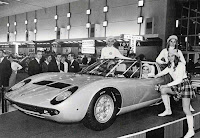
 

The Lamborghini Miura is a sports car built in Italy by Lamborghini between 1966 and 1973. A mid-engined layout had been used successfully in competition, including by the Ford GT40 and Ferrari 250 LM at Le Mans. De Tomaso had produced a road car with this layout, the Vallelunga, but otherwise cars designed for the road were almost uniformly front-engined, rear drive vehicles. The Miura was a trendsetter, the one that made the mid-engined layout de rigueur among two-seater high performance supercars. It is named after the Spanish ranch Miura, whose bulls have a proverbial attack instinct.

Styling
Inspired by the Ford GT40, the Miura astonished showgoers at the 1965 Turin Motor Show where only the chassis was shown, with multiple orders being placed despite the lack of an actual body. Later, Marcello Gandini from Bertone, who would later go on to design almost all of Lamborghini's cars, was chosen to design the body. Both body and chassis were launched five months later at the 1966 Geneva Motor Show. It was a sensation, with its flamboyant bodywork and unusual engine and clam-shell opening hoods on both the front and rear of the car. There was a small trunk located in the very rear of the tail behind the engine.

Miura models
P400
Early Miuras, known internally as P400s, were powered by a 3.9 L version of the famous Lamborghini V12 engine mounted transversely and producing 350 hp (260 kW). 275 P400s were produced between 1966 and 1969, a success for Lamborghini despite its then-steep $20,000 USD price (approx. $114,000 in today's terms). The original Miura engines had the gearbox in the sump of the engine, and the gearbox shared the engine oil for lubrication. This necessitated frequent and consistent oil changes.

P400S
The P400S Miura, also known as the Miura S, made its introduction at the Turin Motorshow in Novermber 1968, where the original chassis was introduced 3 years earlier. It was slightly revised from the P400 with its newly added power windows, bright chrome trim around external windows, new overhead inline console with new rocker switches, minor revision engine internals, notched trunk end panels(allowing for slightly more luggage space). Engine changes were good for an additional 20bhp. Other revisions were limited to creature comforts, such as glove box door, reversed position of cigarette lighter and windshield wiper switch and single release handles for front and rear body sections. 338 P400S Miuras were produced between Dec 1968 and March 1971....

P400SV
The last and most famous Miura, the P400SV or Miura SV featured different cam timing, bigger valves and altered carbs, which increased fuel consumption so much that the factory offered a larger 110 litre fuel tank as an option. These gave the engine an additional 15 bhp, to 385. The engine also had a split sump, in that the gearbox now had its lubrication system separate from the engine, which allowed the use of the appropriate types of oil for the gearbox and the engine. The SV can be distinguished from its predecessors from its lack of "eyebrows" over the headlights and wider fenders to accommodate the new 9-inch wheels and Pirelli Cinturato tires. 150 SVs were produced, including one that was owned by Frank Sinatra.

P400 Jota
This one-off Miura (#747) was the development of Lamborghini Development Driver Bob Wallace in 1972, and only one was built initially as a powerful test mule for future Miuras. Lamborghini were forced to sell this car off due to financial problems in the late seventies. In 1980, upon delivery, the driver and a passenger totalled this particular model and survived without any injuries. Lamborghini has since built a replica of this car.

P400 SVJ
Once customers heard about the Jota, they requested their own "Jota" Miura called the SVJ, and so only 5 were built, all of which still exist.

One of the most high profile model was the Metallic Red Burgundy model (#4934), former property to that of the one of the company's best customer, HIH the Shah of Iran Mohammad Reza Pahlavi, he stored this car under armed guard with another SV in Royal Palace in Tehran.

Later, as he fled the country during the Iranian Islamic Revolution, the car with many others were seized by the Iranian government and was later sold into Dubai in 1995. In 1997 this car was sold via a Brooks auction to Nicholas Cage, at US$490,000, becoming the marque's highest ever price sold in an auction. Cage has since sold the car in 2002.

Roadster
Another one-off, the Miura Roadster (actually more of a targa-model, but without any removable roof) was built as a publicity stunt. After having been exhibited at several auto salons the car was sold to a group of companies in the metal business who turned it into a display-vehicle showcasing the possibilities of using their various metal alloys in cars. The car still exists today and has been frequently replicated.

P400 SVJ Spider
This version of the Miura was actually displayed in 1981 at the Geneva Motor Show by Lamborghini, shortly after the new CEO Patrick Mimran took over the factory. The car was actually the yellow Miura S presented at the 1971 Geneva Motor Show, reconstructed in 1980 in Spider by the Swiss Lamborghini Importer, Lambomotor AG. The Miura SVJ Spider was displayed on the Lamborghini stand with the other 1981 new models (Jalpa and LM002), equipped with wide wheels and a rear wing, in the context of the marque's revival, it was considered as a prototype for a possible limited series of Miura Spider.

Details
Early Miuras were notorious for being a fire hazard. The problem was caused by Lamborghini's decision to use Weber 40 IDL 3C1 carburetors which were designed exclusively for racing applications and weren't suitable for road use. The problem occurred when the car sat idling (e.g. at a stoplight), the area above the throttles filled with fuel which often ignited when the car accelerated away from the stop. One of Lamborghini's engineers devised a modification for the carburetors which created a fuel-return. Ferrari, who used these same carburetors in one of their cars, and suffered the same problems, were able to use Lamborghini's modification to solve it.

Some other interesting details: the position of the fuel tank is at the front causing the vehicle to have less weight at the front as the fuel tank gets lighter (closer to empty), thus making the car more difficult to handle at 150+ MPH. Another detail is that the doors resemble a bull's horns when it is opened wide (Lamborghini's logo itself depicts a raging bull).

In 2004, Sports Car International named this car number four on both the list of Top Sports Cars of the 1960s and Top Sports Cars of the 1970s. The car was ranked number four on the list of the Top Sports Car of All Time.

Specifications
Engine
    * Configuration: 60 degree V12, DOHC
    * Engine displacement: 3929cc
    * 350 bhp (261 kW) at 7000 rpm (Base)
    * 370 bhp (276 kW) at 7700 rpm (S)
    * 385 bhp (287 kW) at 7850 rpm (SV)

Performance
    * Top speed: 288 km/h (179 mph)
    * 0-100 km/h: 5.5 second
    * Quarter Mile: ~14 second

Lamborghini Islero, 1968

Lamborghini Islero, 1968


Lamborghini Islero was produced by Lamborghini between 1968-1970 and featuring the Lamborghini V12 engine. It was the replacement for the 400GT. The car debuted at the 1968 Geneva Auto Show.

The Islero (pronounced "eez-LEHR-oh") was named after a bull that killed famed matador Manuel Rodriguez "Manolete" on August 28, 1947.

Since Carrozzeria Touring, the company that designed Lamborghini's chasis, was bankrupt, Carrozzeria Marazzi was the next logical choice as it was funded by Mario Marazzi, an old employee of Touring. The design was essentially a rebody of the 400GT, but the track was altered to allow for wider tires and while the Islero's body suffered from a lack of proper fit between the panels, its good outward visibility, roomier interior, and much improved soundproofing made it an improvement over previous models. It had a 325 hp, 4L V12 engine, 5 speed transmission, fully independent suspension, and disc brakes. Its top speed was rated at 155 mph. Only 125 Isleros were built.

An updated Islero, dubbed the Islero S was released in 1969. The engine in this model was tuned to 350 hp but the torque remained the same. There were quite a few styling changes including brightwork blind slots on the front fenders, an enlarged hood scoop (which supplied air to the interior of the car, not the engine), slightly flaired wheel arches, tinted windows, round side marker lights (instead of tear drops on the original), and a fixed section in the door windows. Various other changes included larger brake discs, revised rear suspension and revamped dashboard and interior. The top speed of the S improved to 161 mph or 260 km/h. Only 100 examples of the Islero S were built, bringing the production total of the Islero nameplate to 225 cars. Ferruccio Lamborghini himself had an Islero as his daily drive car during that era.

Wednesday, January 26, 2011

Lamborghini Gallardo LP 560-4 Bicolore Special Launched at Qatar Motor Show


The 2011 Qatar Motor Show that runs from January 26 to 29 appears to have captured the attention of the VW Group as a whole. Following yesterday's unveiling of the VW XL1 hybrid coupe concept, the German familia's sportiest brand, Lamborghini, lifted the wraps off a special edition version of the Gallardo called Bicolore.

The limited run model will be produced for the European and Asian-Pacific markets in the LP 560-4 guise, which means it gets a 560HP V10 and all-wheel drive, while for the American market it will be only available in the version LP 550-2 featuring a 550HP V10 and rear-wheel drive configuration.

As its name implies, the special series features a unique two-tone finish with a matching interior. On the outside, the pillars, roof, engine hood and rear spoiler are painted in a pastel black that contrasts perfectly with the lower area of the body, available in a choice of five shades (Giallo Midas, Arancio Borealis, Grigio Telesto, Bianco Monocerus and Blu Caelum).

The Gallardo's exterior appearance is further enhanced by the 15-spoke forged alloy wheels finished in titanium gray enamel, and the gloss black finish air-intakes, front spoiler and upper section of the rear diffuser.

The two-tone theme is repeated inside, but in a more understated manner. The instrument panel, seats, door panels and other elements in the passenger compartment are upholstered in black leather with contrast stitching colored to match the exterior paintwork (yellow, orange, blue or gray). The black bezel of the e-gear transmission on the center console completes the look.

Pricing is to be announced at a later date.


_______________________________GALLERY_______________________________


Monday, January 24, 2011

Lamborghini Murcielago Successor gets F1-inspired Pushrod Suspension, Debut Confirmed for Geneva Show


It’s official: the much-awaited successor to the Lamborghini Murcielago (named either Aventador or Jota, depending on who you ask), will be unveiled at the 2011 Geneva Motor Show in early March. As well as officially confirming the supercar's show debut, Lamborghini also revealed details on the suspension.

The Murcielago's replacement will come with an F1-inspired pushrod spring and damper concept, tuned to "meet the needs of a high-performance road-going vehicle." Mores specifically, Lamborghini said that instead of linking to the wheel mounts, the spring/damper elements are connected to the body shell structure, in a transverse position. Pushrods and relay levers/rockers transmit the forces from the wheel mounts to the spring/damper elements, offering a series of benefits.

Because of this setup, wheel control and damper are separate units, improving handling and the reaction of the springs/dampers. This allowed engineers to use less stiff springs, increasing comfort. Last but not least, the shock absorbers are equipped with a hydraulic lifting system, capable of raising the front end of the car by 4 centimeters (1.57 inches) at the push of a button. Thus, small obstacles can be negotiated without causing damage to the front bumper.

All suspension parts are made from a forged aluminum alloy.

As previously reported, the Lambo is motivated by a newly developed 700HP 6.5-liter V12 engine, while stopping power comes from 400mm 6-pot caliper ventilated front and 380mm 4-pot caliper rear carbon ceramic brakes. The LP700-4 runs on 19-inch front and 20-inch rear wheels, shod in 255/35 and 335/30 tires respectively.

The steering system is hydraulic with three different servotronic settings, ranging from the hardcore “corsa” racetrack mode to less demanding setups.

There’s no official information on pricing yet, but one German dealer has already listed the car as the “Aventador LP700-4” for €309,900 (US$423,757) with 19% tax.

By Csaba Daradics


_______________________________GALLERY_______________________________


Tuesday, January 18, 2011

Friday, January 14, 2011

2010 Lamborghini Cnossus

2010 Lamborghini Cnossus Concept Front View Lamborghini Cnossus 2010
2010 Lamborghini Cnossus
2010 Lamborghini Cnossus Concept Front Side View Lamborghini Cnossus 2010
2010 Lamborghini Cnossus
Lamborghini Cnossus Design Study 8 1024x682 Lamborghini Cnossus 2010
2010 Lamborghini Cnossus
2010 Lamborghini Cnossus Concept Rear Side Top View Lamborghini Cnossus 2010
2010 Lamborghini Cnossus
2010 Lamborghini Cnossus Concept Rear View Lamborghini Cnossus 2010
2010 Lamborghini Cnossus

2010 Lamborghini Cnossus

2010 Lamborghini Cnossus Concept Front View Lamborghini Cnossus 2010
2010 Lamborghini Cnossus
2010 Lamborghini Cnossus Concept Front Side View Lamborghini Cnossus 2010
2010 Lamborghini Cnossus
Lamborghini Cnossus Design Study 8 1024x682 Lamborghini Cnossus 2010
2010 Lamborghini Cnossus
2010 Lamborghini Cnossus Concept Rear Side Top View Lamborghini Cnossus 2010
2010 Lamborghini Cnossus
2010 Lamborghini Cnossus Concept Rear View Lamborghini Cnossus 2010
2010 Lamborghini Cnossus

Tuesday, January 11, 2011

eBay Find: Luigi Colani’s 1970 Lamborghini Miura Le Mans Concept Car


Unveiled in 1970, the Lamborghini Miura Le Mans was an out-of-this-world concept car, envisioned by legendary Italian designer, Luigi Colani. According to Colani’s website, the design study was a “two-part hybrid car”, with a Miura chassis rear section and front passenger cabin designed “like the cockpit of a glider”.

It was used as a show car for about four years, when it suddenly went under the radar, only to be discovered 30+ years later by Bad Influence Hot Rods (BIHR), at an estate auction in Indiana. The new owner put it up for sale last October for $79,000, but the reserve wasn’t met. Now it re-surfaced on eBay for a starting bid of $74,999.

Unfortunately, the Miura Le Mans hasn’t aged very well, as the canopy is broken into several pieces and the engine is gone. However, many parts are still there, including the rear and front suspension, golden rear alloys with blue knockoffs, double nose wheels, brakes, calipers and steering.

While BIHR says that this should be an easy car to restore, we’re not that convinced, but whoever decides to pick it up for this kind of money might as well go all the way. Otherwise, it could make for an interesting coffee table…

By Csaba Daradics

Link: eBay


_______________________________GALLERY_______________________________