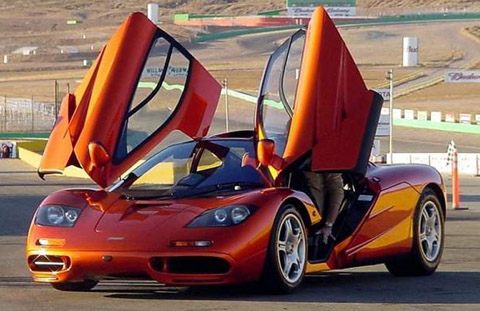
mclaren f1 2011
|
|
|
|---|
Saturday, February 5, 2011
Friday, February 4, 2011
McLaren MP4-12C 2011

Wednesday, February 2, 2011
McLaren MP4-12C Enters Production, 1,000 Cars to be Built this Year [with Video]

McLaren Automotive's brand new MP4-12C has reached another milestone with the start of production at the McLaren Technology Centre (MTC) in Woking, England. The British sports car maker said it plans to build up to 1,000 examples of the MP4-12Cs this year, with most cars to be manufactured in a bespoke new £40m McLaren Production Centre, which is due for completion in May on a site neighboring the MTC facility.
The MP4-12C was first presented to the public at the Goodwood Festival of Speed in southern England in July 2010, ahead of a North American debut at the Pebble Beach Concours d’Elegance in August of the same year.
It is powered by a mid-mounted 3.8 liter twin-turbocharged V8 with 600HP and 443 lb-ft, developed in-house by McLaren, and can complete the standard 0-100km/h (62mph) sprint in under 3.0 seconds and the quarter mile in around 11 seconds, while reaching a top speed in excess of 200mph or 322km.
Prices for the MP4-12C start at around €200,000 in mainland Europe, £168,500 in the UK and at $229,000 in the US.
Today, McLaren also released a new short film called 'Best of 2010', which features appearances from F1 racing stars Lewis Hamilton and Jenson Button, visitors’ reactions to the 12C at its debut events as well as new footage of the car winter testing at Dunsfold Aerodrome. Scroll down to watch it.
_______________________________GALLERY_______________________________


_______________________________________________________________________
_______________________________VIDEO_______________________________
Tuesday, February 1, 2011
Man Amasses Ridiculously Awesome Gulf Oil-Liveried Racing Car Collection

The ROFGO Gulf Collection by Duncan Hamilton is one man's dream of assembling the largest assortment of racing cars ever to compete in the legendary colors of Gulf Oil. The collection comprises 14 of the most prominent Gulf Oil-liveried competition cars and has been created by Duncan Hamilton & Co.’s Chairman, Adrian Hamilton, for an unnamed but obviously passionate and extremely wealthy client.
All 14 cars were tracked down and acquired in just two years. The collection includes a variety of models ranging in age from the 1967 Mirage, which was the first Gulf-liveried car to run at Le Mans, to the 2010 Lamborghini Gallardo that competed in the GT2 Championship.
Commenting on the collection, Adrian Hamilton said: “My career has been punctuated by many remarkable cars – eg the one and only Mercedes-Benz 196 Grand Prix car in private hands, some nine Ferrari 250 GT0s, 20 GT40s, seven Porsche 917s and numerous Jaguar C and D-Types etc – but few projects have been as enjoyable and satisfying as this one. Like all racing enthusiasts I’ve grown up with the Gulf brand and it is a tremendous privilege to be able to build such a unique and lasting tribute to one of the greatest names in our sport. I am extremely indebted to my client for the opportunity.”
A total of 12 cars from the ROFGO Gulf Collection by Duncan Hamilton will get their first public outing for all to see at Retromobile, an annual show of classic road and racing cars, which takes place at Porte de Versailles in Paris, from February 2 to 6.
In chronological order the 14 cars are:
- 1967 Mirage
Chassis No.10002 – the first Gulf-liveried car to run at Le Mans
- 1968 Ford GT40
Chassis No.1084 – 4th, SPA 1000 km, Hawkins/Hobbs
- 1969 Brabham BT26
Chassis No.BT26/4 - 1st German GP, Ickx
- 1970 McLaren M14
Chassis No.M14/A2 – 2nd South African GP, Hulme
- 1971 Porsche 917
Chassis No.026 – 2nd, Le Mans 24 Hours, Attwood/Muller
- 1970 Porsche 908/3
Chassis No.12 – Nürburgring 1000 km, Siffert, DNF
- 1972 McLaren M20
Chassis No.M20/3 – 1st, Watkins Glen, Hulme
- 1974 Mirage
Chassis No.704 – 4th, Le Mans 24 Hours, Bell/Hailwood
- 1994 Kremer K8
Chassis No.K8/07/SP – 6th, Le Mans 24 Hours, Bell/Lassig/Donovan
- 1996 McLaren F1 GTR Longtail
Chassis No.022 – 3rd, Hockenheim 4 Hours, Bscher/Nielson
- 2006 Courage C65 LMP2
Chassis No.07 – 7th, Le Mans 24 Hours, Gosselin/Ojeh/Ragues
- 2008 Aston Martin DBR9
Chassis No.007 – 4th in GT1, Le Mans 24 Hours, Frentzen/Piccili/Wendlinger
- 2009 Aston Martin LMP1
Chassis No.DBR1-2/2 – 1st, Asian Le Mans series, Okayama, Mucke/Primat
- 2010 Lamborghini Gallardo
GT2 Championship, Giroix/Goethe
_______________________________GALLERY_______________________________
Tuesday, January 18, 2011
The McLaren MP4-12C of Chronograph Watches

McLaren and TAG Heuer are celebrating their 26-year long partnership as well as the 20th anniversary of the original McLaren F1 with the launch of the limited edition TAG Heuer MP4-12C Chronograph watch. Taking inspiration from the upcoming MP4-12C supercar, the watch boasts a matching color scheme and is built from exotic materials such as carbon fiber.
The lightweight composite material was used for the dial, which features sapphire inserts that reveal the mechanism. The latter is protected by a highly durable titanium case, also minimizing weight. Other highlights include the alcantara leather strap evoking the MP4-12C’s interior, and orange luminescent markers on the hands, complemented by orange stitching.
Pilots and track drivers will appreciate the Flyback function, which allows the chronograph to be reset to zero and instantly restarted by pressing only once on the push button. There’s also a tachymeter at hand, indicating what distance is travelled, while the chronograph can record time intervals between two locations.
“I love watches and have always wanted to design one myself. The TAG Heuer MP4-12C Chronograph was a particularly interesting project as we have combined our passion for precision technology, engineering and performance and included some of the most outstanding design features and materials that can be found in the MP4-12C”, said Frank Stephenson, Design Director McLaren Automotive.
The TAG Heuer MP4-12C Chronograph will be produced in a limited run of 1,000 units. Those interested can purchase the watch through McLaren later this year.
As for the car that inspired the creation of the chronograph, the MP4-12C is powered by a 600HP mid-mounted 3.8-liter twin-turbocharged V8, developed in-house by McLaren. Capable of reaching 100 km/h (62 mph) in less than 3 seconds and a top speed of 320+ km/h (200+ mph), the MP4-12C will hit the European market in spring 2011, at a base price of €200,000 in Germany and £168,500 in the UK. U.S. pricing will be released at a later date.
By Csaba Daradics
_______________________________GALLERY_______________________________

Monday, January 17, 2011
McLaren F1 GTR, 1995
In total, nine McLaren F1 GTRs would be built for 1995.
McLaren F1 GTR '96
To follow up on the success of the McLaren F1 GTR into 1996, McLaren further developed the '95 model, leading to a size increase but weight decrease. Nine more F1 GTRs were built to 1996 spec, while some 1995 cars were still campaigned by privateers. McLaren F1 GTR '96 chassis #14R is notable as being the first non-Japanese car to win a race in the All-Japan Grand Touring Car Championship (JGTC). The car was driven by David Brabham and John Nielsen. The weight was reduced with around 100 kg from the 1995 GTR edition and the engine was kept detuned at 600 HP to comply with racing regulations.
McLaren F1 GTR '97
With the F1 GT homologated, McLaren could now develop the McLaren F1 GTR for the 1997 season. Weight was further reduced and a sequential transaxle was added. The engine was slightly destroked to 6.0L instead of the previous 6.1L. Due to the heavily modified bodywork, the McLaren F1 GTR '97 is often referred to as the "Longtail" thanks to the rear bodywork being extended to increase rear downforce. A total of ten McLaren F1 GTR '97s were built. The weight was reduced to a total of 910 kg.
McLaren F1, 1993
The car features numerous proprietary designs and technologies. It is lighter and has a more streamlined structure than even most of its modern rivals and competitors despite having one seat more than most similar sports cars, with the driver's seat located in the middle. It features a powerful engine and is somewhat track oriented, but not to the degree that it compromises everyday usability and comfort. It was conceived as an exercise in creating what its designers hoped would be considered the ultimate road car. Despite not having been designed as a track machine, a modified race car edition of the vehicle won several races, including the 24 Hours of Le Mans in 1995, where it faced purpose-built prototype race cars. Production began in 1992 and ended in 1998. In all, 106 cars were manufactured, with some variations in the design.
The idea was first conceived when Murray was waiting for a flight home from the fateful Italian Grand Prix in 1988; Murray drew a sketch of a three seater sports car and proposed it to Ron Dennis, pitched as the idea of creating the ultimate road car, a concept that would be heavily influenced by the Formula One experience and technology of the company and thus reflect that skill and knowledge through the McLaren F1.
The car was first unveiled at a launch show, 28 May 1991, at The Sporting Club in Monaco. The production version remained the same as the original prototype (XP1) except for the wing mirror which, on the XP1, was mounted at the top of the A-pillar. This car was deemed not road legal as it had no indicators at the front; McLaren was forced to make changes on the car as a result (some cars, including Ralph Lauren's, were sent back to McLaren and fitted with the prototype mirrors). The original wing mirrors also incorporated a pair of indicators which other car manufacturers would adopt several years later.
Engine
Gordon Murray insisted that the engine for this car be naturally aspirated to increase reliability and driver control. Turbochargers and superchargers increase power but they increase complexity and can decrease reliability as well as introducing an additional aspect of latency and loss of feedback, the ability of the driver to maintain maximum control of the engine is thus decreased. Murray initially approached Honda for an NA powerplant with 550 bhp (410 kW; 560 PS), 600 mm (23.6 in) block length and a total weight of 250 kg (551 lb), it should be derived from the Formula One powerplant in the then-dominating McLaren/Honda cars.
Chassis and body
The McLaren F1 was the first production road car to use a complete carbon fiber reinforced plastic (CFRP) monocoque chassis structure. Aluminium and magnesium was used for attachment points for the suspension system, inserted directly into the CFRP.
The car features a central driving position - the driver's seat is located in the middle, ahead of the fuel tank and ahead of the engine, with a passenger seat slightly behind and on either side. The doors on the vehicle move up and out when opened, and are thus of the type butterfly doors.
The engine produces high temperatures under full application and thus cause a high temperature variation in the engine bay from no operation to normal and full operation. CFRP becomes mechanically stressed over time from high heat transfer effects and thus the engine bay was decided to not be constructed from CFRP.
Aerodynamics
The overall drag coefficient on the standard McLaren F1 is 0.32, compared with 0.36 for the faster Bugatti Veyron, and 0.357 for the current holder of the fastest car world record (as of 2008) - the SSC Ultimate Aero TT (in terms of top speed). The vehicle's frontal area is 1.79 square meters and the total Cx is 0.57. Due to the fact that the machine features active aerodynamics these are the figures presented in the most streamlined configuration.
The normal McLaren F1 features no wings to produce downforce (compare the LM and GTR editions), however the overall design of the underbody of the McLaren F1 in addition to a rear diffuser exploits ground effect to improve downforce which is increased through the use of two electric fans to further decrease the pressure under the car. A "high downforce mode" can be turned on and off by the driver. At the top of the vehicle there is an air intake to direct high pressure air to the engine with a low pressure exit point at the top of the very rear. Under each door is a small air intake to provide cooling for the oil tank and some of the electronics. The airflow created by the electric fans not only increase downforce, but the airflow that is created is further exploited through design, by being directed through the engine bay to provide additional cooling for the engine and the ECU. At the front, there are ducts assisted by an electric suction fan for cooling of the front brakes.
There is a small rear spoiler on the tail of the vehicle, which is dynamic, the device will adjust dynamically and automatically attempt to balance the center of gravity of the car under braking - which will be shifted forward when the brakes are applied. Upon activation of the spoiler a high pressure zone is obviously created in front of the flap, this high pressure zone is exploited—two air intakes are revealed upon application that will allow the high pressure airflow to enter ducts that route air to aid in cooling the rear brakes. The spoiler increases the overall drag coefficient from 0.32 to 0.39 and is activated at speeds equal to or above 40 mph (64 km/h) by brake line pressure.
McLaren M6GT, 1969
The M6 name was later used in the development of a closed-cockpit sports car for the 24 Hours of Le Mans and known as the M6GT. The company's plan to homologate it for the FIA's Group 4 regulations was however never completed, and only a few M6GT prototypes were finished by McLaren and Trojan. Two M6GTs were later converted to road cars, one of which became Bruce McLaren's personal transport.
Development
Bruce McLaren gathered several designers to develop the McLaren M6A during the off-season in early 1967. Along with McLaren himself, Robin Herd, Gordon Coppuck, Tyler Alexander, and Don Beresford all worked on the layout of the McLaren M6A's chassis and bodywork. The car featured the first monocoque chassis constructed by McLaren, while the bodywork was specifically shaped to increase downforce suited for the Can-Am circuits. McLaren's team also expanded into engine development, creating a fuel injection system for their Chevrolet V8s. Another addition to the team was a new tire supplier, with Goodyear replacing Firestone in exchange for a testing and development program.
The first McLaren M6A was completed in spring 1967, and brought to the nearby Goodwood Circuit for testing. Bruce McLaren Motor Racing carried out over 2000 miles of testing at the circuit in preparation for the upcoming Can-Am season, tuning the car as well as gathering data for Goodyear's use. As two further McLaren M6A were completed, the team shipped the cars to North America to prepare for the opening race of the season. A final addition to the cars was a coat of orange paint. This new McLaren Orange color scheme would eventually become synonymous with Bruce McLaren and the team.
The retirement of the McLaren M6A, McLaren entrusted Trojan with constructing duplicates which could be sold to customers. These M6Bs were nearly identical to the McLaren M6A but were sold without an engine. Several other M6Bs were also modified to fit closed-cockpit bodywork.
Racing history
The 1967 Can-Am season began in September at Road America. Bruce McLaren's M6A qualified on pole position with a new track record, while teammate Denny Hulme's car led once the race began. Although McLaren's car suffered an oil leak and failed to finish, Hulme was able to earn the car's first victory. The next two events had the team running away from the opposition, with Hulme and McLaren finishing first and second consecutively. The roles were however swapped over the next two races as it was McLaren who won on both occasions, but problems with Hulme's car allowed McLaren to take the lead in the points standings going into the final round. For the finale at the Stardust Grand Prix, problems with the Chevrolet motors led to blown engines and neither car reaching the finish. However, with their performance over the season, Bruce McLaren secured the 1967 Can-Am Challenge Cup, while Hulme was ranked second only three points behind.
As Bruce McLaren Motor Racing moved to developing the M8A, the M6Bs began to be delivered to customers for the 1968 season. Several of the McLaren M6A were also sold with Roger Penske purchasing one car for defending United States Road Racing Championship (USRRC) champion Mark Donohue. Donohue won several USRRC events that season and earned his second championship. Donohue also later won a race in Can-Am, beating the newer McLaren M8As. After the cancellation of the USRRC after 1968, the M6As and M6Bs continued to be used into the early 1970s but none were able to achieve victory against their newer competitors.